Oxford & Loom may earn a commission or have a financial relationship with brands featured on this site, including brands under common ownership. See our Advertising Disclosure.
Sneaker sizing and dress shoe sizing are not the same exercise, and most men size a dress shoe the way they size a sneaker: half a size up, room to wiggle, break it in later. That approach produces exactly the problems it's meant to avoid: heel slip, blown-out leather at the crease, and blisters that show up right when you need the shoes to perform.
A dress shoe that fits correctly should feel snug when new and mold to your foot over the first few wears, not the other way around. Here's what correct actually looks like, from heel to toe.
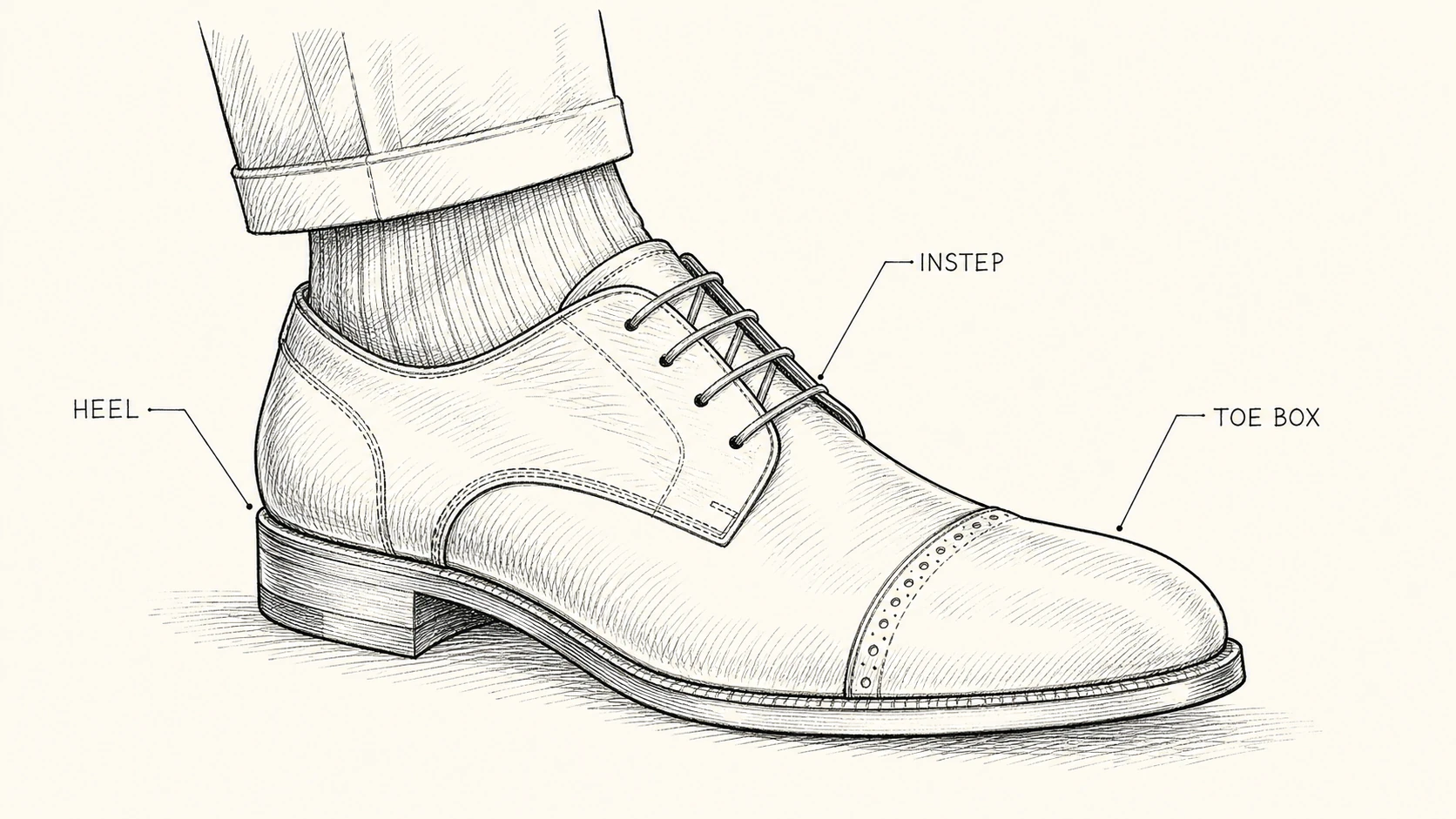
The heel should not move
Some heel slip in a brand-new leather-soled shoe is normal for the first few wears, before the insole and leather lining break in. But it should be minor: a slight lift, not a shoe flapping off your foot with every step. If your heel is moving more than that, or you're compensating with an extra pair of socks, the shoe is too big, not "not broken in yet."
Persistent heel slip is one of the fastest ways to wear through a heel counter and destroy a shoe's shape early. It's also the single most common fit mistake we see men make, more common than a snug toe box or a rigid instep.
The toe box needs room, not space
There's a difference between having room to wiggle your toes and having so much space that your foot slides forward inside the shoe on every step. Press a thumb down at the front of the shoe with your foot fully in it: you want roughly a thumb's width of space between your longest toe and the end of the shoe. Less than that, and the shoe will pinch after a few hours. More than that, and your foot will slide forward, jamming your toes anyway and adding wear at the crease from the extra shoe material folding.
Width matters as much as length
Most men know their length but have never been measured for width, and width is often the actual problem when a shoe "doesn't fit right" despite being the correct length. A shoe that's too narrow will pinch across the ball of the foot no matter how much room exists lengthwise. A shoe that's too wide lets the foot shift side to side, which does the same damage as a too-long shoe: stretched leather, blisters, early breakdown.
If you've never had your feet measured for width, it's worth doing once, in person, at a shop that carries multiple widths in the last you're considering. Many quality dress shoe brands run narrower than casual footwear, so a size that fits a sneaker often needs to go up half a size, or into a wider width, in a dress shoe.
The instep and arch shouldn't fight the leather
A shoe with laces should let you adjust for instep height. If you're cranking the laces all the way closed and still feel pressure across the top of your foot, the shoe's instep is too low for your foot, and no amount of breaking in fixes that. This matters even more for loafers, since there's no lacing to compensate: the fit has to be close to right out of the box, particularly through the instep and vamp.
What a real break-in period actually fixes
Leather does soften and shape itself to a foot over time, especially across the vamp and around the ball of the foot. That's a legitimate break-in effect, and it's why a correctly sized shoe can feel slightly snug on day one and noticeably better by day five. What a break-in period does not fix is a fundamentally wrong size: a shoe half a size too big will still slip at the heel after twenty wears, because there's no amount of softening that closes a gap that large. If a pair still hurts or slips after a week of regular wear, the issue is sizing, not patience.
Socks change the equation slightly
Dress socks are thinner than casual socks, and that thickness difference matters when you're trying on shoes. Bring the socks you'll actually wear with a given pair: thin dress socks for oxfords and derbies, and consider going without for loafers in warm weather, since trying on a dress shoe over a thick athletic sock will throw off the fit read entirely.
Signs a shoe fits, in one list
- Minimal heel slip that settles within the first few wears
- About a thumb's width of space beyond the longest toe
- No pinching across the ball of the foot or pressure across the instep
- The shoe bends at the ball of the foot, not the middle of the arch
- You can wear it a full day without needing to loosen laces or shift your foot
Getting this right pays off beyond comfort. A shoe that fits properly holds its shape longer, resoles better, and looks sharper with dress pants or a suit because it isn't collapsing or gapping at the seams. Getting the leather color right relative to the rest of the outfit matters too. See our guide to matching belts and shoes for that half of the equation, and business casual, decoded for where dress shoes fit into a less formal dress code. Once fit and color are sorted, our full shoes coverage runs through the rest of what's worth owning.
Bottom Line
A correctly fitted dress shoe feels close and secure when new, with a thumb's width of toe room and a heel that barely moves. If you're relying on a "break-in period" to fix pinching, slipping, or pressure, the shoe is the wrong size, not a shoe that needs time.