Oxford & Loom may earn a commission or have a financial relationship with brands featured on this site, including brands under common ownership. See our Advertising Disclosure.
Business casual covers a wide range, stretching from "jeans and a collared shirt are fine" to "you'll want a blazer, just skip the tie," and the exact same outfit can be underdressed at one office and overdressed at another. That range is what makes the term useless on its own. What actually works is a formula: three categories, a short list of options in each, and a rule for combining them.
Here's how to read your specific office and build outfits that hold up in it without a morning spent second-guessing the whole thing.
What business casual actually means
Most offices fall somewhere on a line between two poles. On one end: casual Friday energy, where dark jeans, a clean sweater, and leather sneakers cover it. On the other: smart casual with a harder edge, where a sport coat, dress trousers, and a collared shirt are the baseline and jeans never show up at all.
Industry shifts that line more than title does. A law firm's business casual usually sits close to a suit with the tie removed. A design studio's version might be closer to well-fitted streetwear. The label stays the same across both; the actual clothing barely overlaps at all.
The fastest way to place your office on that line is to look at what the most senior people wear on a normal Tuesday, not what the dress code memo says. Policies lag reality by years. The person three levels up is a better guide than the employee handbook.
The formula that works almost everywhere
Once you know roughly where your office sits, this combination flexes to match it:
- Top: an oxford shirt or a fine-gauge knit polo, worn alone or under a sweater
- Bottom: chinos or a lightweight wool trouser, in a dark neutral
- Shoes: leather derbies, loafers, or clean white sneakers, matched to how dressy the top and bottom read together
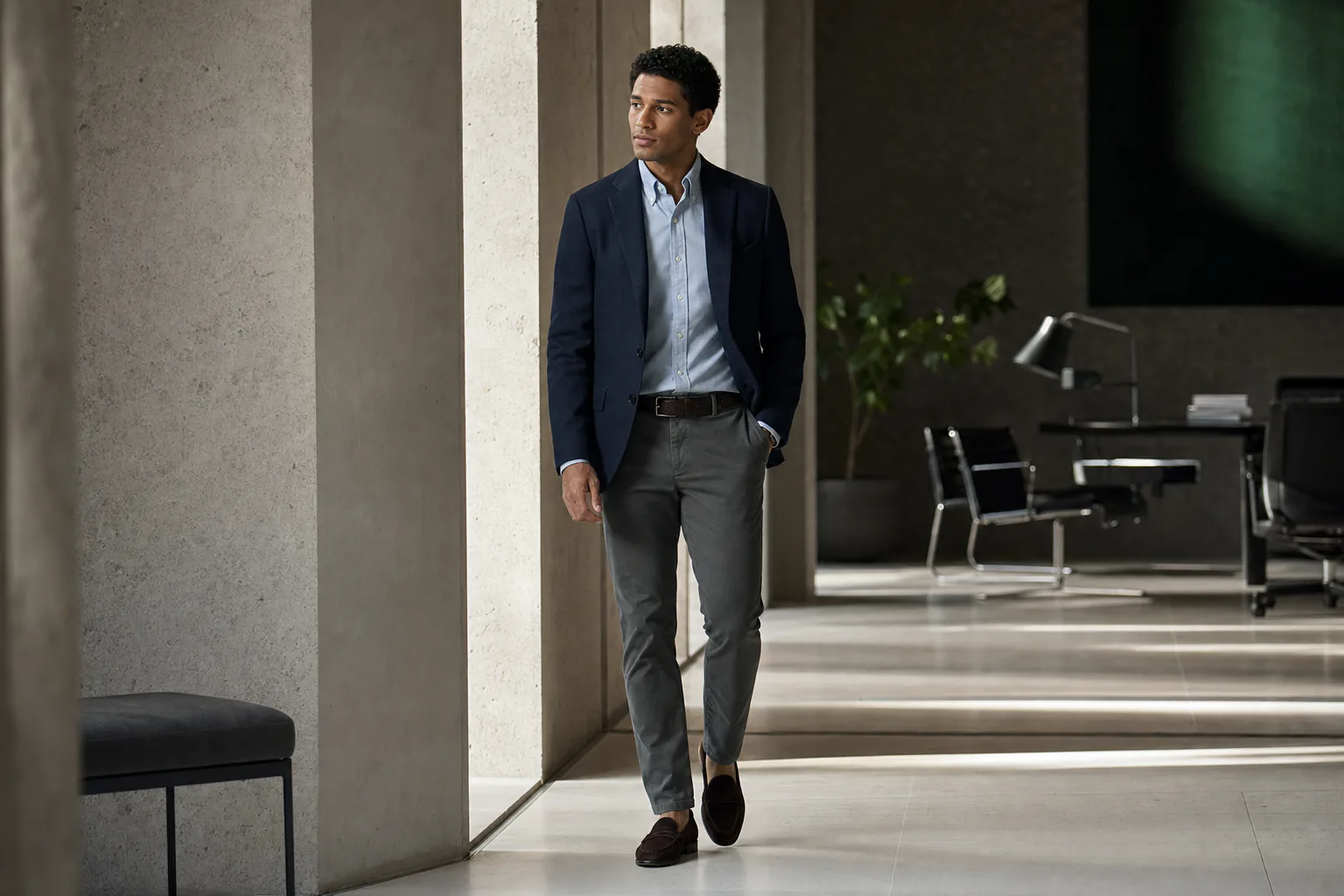
Add a blazer or sport coat to push the whole outfit dressier without changing the shirt or trousers underneath it. Drop to a crewneck sweater or remove the jacket entirely to pull it more casual. The pieces stay the same. Only the combination shifts.
What the room tells you
A few signals tell you more than any written policy:
- What clients or visitors see when they walk through the office
- Whether senior leadership wears a jacket on a normal day or saves it for external meetings
- How the dress code shifts on days with client calls versus days without them
When in doubt, dress one notch above the average in the room. It reads as intentional rather than overdressed, and it's a much smaller mistake than showing up underdressed to something that mattered more than you expected.
New jobs and new offices are where this matters most. Spend the first two weeks dressing slightly dressier than you think you need to, take note of what actually gets worn around you, and adjust down once you have real information instead of a guess made on day one.
What to skip entirely
A few pieces cause more confusion than they solve in a business casual office:
- Novelty ties or anything meant to be a conversation piece
- Athletic wear of any kind, including "athleisure" pieces that look like gym clothes up close
- Distressed or heavily faded jeans, even on offices that allow denim
- Shorts, regardless of the season or the building's air conditioning habits
None of these are dramatic mistakes. They're just distractions. Business casual dressing works best when nothing about the outfit draws a second look, good or bad.
The blazer question
A blazer is the single fastest way to move an outfit up the formality scale, which is exactly why it causes so much confusion. Worn over the oxford shirt and chinos from the formula above, it turns a casual combination into something that reads as prepared for a client meeting. Worn with jeans and sneakers, it can look like a costume instead of an outfit.
The rule that keeps it simple: only add a blazer over pieces that already look finished on their own. If the shirt and trousers underneath wouldn't hold up without the jacket, the jacket is doing too much work, and it usually shows.
Footwear does more work than people expect
Shoes shift the read on an outfit more than almost anything else. The same shirt and trousers look considerably dressier in a leather derby than in a sneaker, even though nothing else changed. If your office runs toward the dressier end, get the fit of your dress shoes right before worrying about anything else in the closet. If it runs more relaxed, a clean pair of white leather sneakers does the same job the loafer would in a stricter office.
Bottom Line
Business casual works as three flexible categories, top, bottom, and shoe, calibrated to match what the room actually expects. Watch what the people a few levels up are wearing, keep the formula above in rotation, and adjust the jacket and shoes rather than rebuilding the whole outfit every time the dress code shifts. The daily guessing mostly disappears once those pieces are in place. For the rest of the wardrobe this rests on, our shirts and tops coverage is the place to start.